The problem
A soldier carrying a GPS tracker carries a battery, and a battery is a thing that runs out at the worst possible time, needs charging, needs replacing, and adds weight.
But a soldier walking is doing mechanical work thousands of times an hour. The premise here is that the boot should power its own electronics.
Making a shoe generate electricity
A triboelectric nanogenerator produces charge when two dissimilar materials touch and separate — which is exactly what a boot sole does with every step. The engineering problem is that a plain TENG doesn’t produce much.
The project’s core idea is laser surface texturing: patterning the polymer surface with a laser so there is more surface area making contact, and therefore more charge per step.
That produced a set of findings that had to be established experimentally rather than assumed:
- Tribo pair. PTFE–Al, PDMS–Al, polyimide–Al, FEP–Al and PET–Al were all characterised against each other.
- Wavelength. 355 nm gives maximum absorption in the tribo-negative material.
- Pattern geometry. Dot, line and mesh patterns were fabricated and compared. Line patterns outperformed the others.
- Layer thickness. Simulation and experiment across 50–500 µm PTFE. Surface potential rises with thickness, but output falls — the loss through a thicker dielectric at the electrode interface costs more than the potential gains. A result that runs opposite to intuition.
- Real foot conditions. Optimised against human foot force of 10–150 N, step frequencies of 1–7 Hz, and tribo-layer gaps from 1 to 12 mm, with lifecycle testing on a dynamic shaker.
Getting the power out
A TENG produces high-voltage, low-current, irregular AC — almost the least convenient electricity there is. Turning that into something that charges a battery is a separate problem from generating it.
This is the part Atharva worked on: the impedance-matching and rectification circuit, tuning source impedance from 885 MΩ down to 88.4 MΩ by parallel capacitance. It improved battery charging efficiency by 54%. Patent filed.
What was delivered
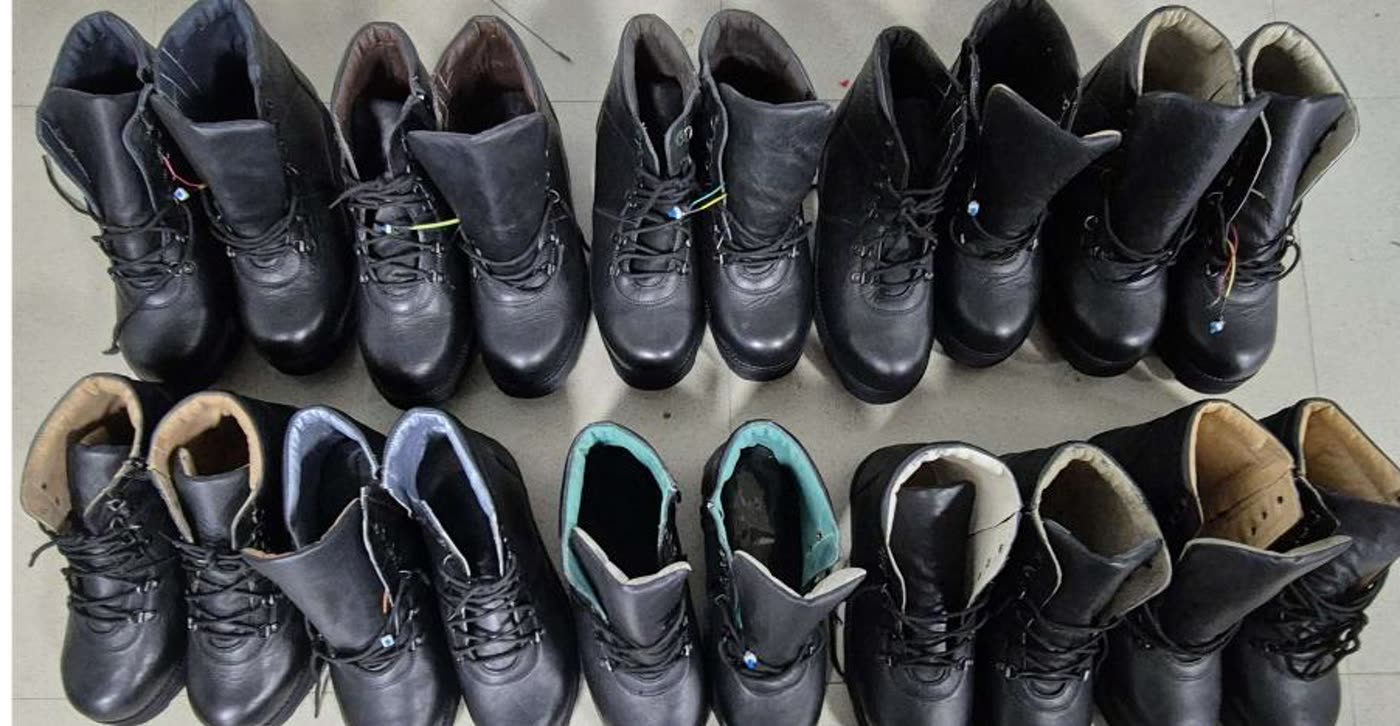
Ten pairs of power-harvesting boots, each integrating the TENG, the power-harvesting module, GPS and RFID — plus RFID and GPS receiver units. Delivered to ARDE, Pune in July 2024.
The intended use: locating soldiers’ positions without a battery to maintain, and self-powered RFID for identification and attendance records.
Note
A three-year DRDO/ARDB-funded project led by Prof. I.A. Palani at IIT Indore, with a team. Atharva joined it in his first year — it was the first thing he worked on after being given access to that lab, and it is the reason he was.